FTSE Reverses Turning Red as BoE Delivers Hawkish Hike to 4.00%
FTSE Reverses Turning Red as BoE Delivers Hawkish Hike to 4.00%
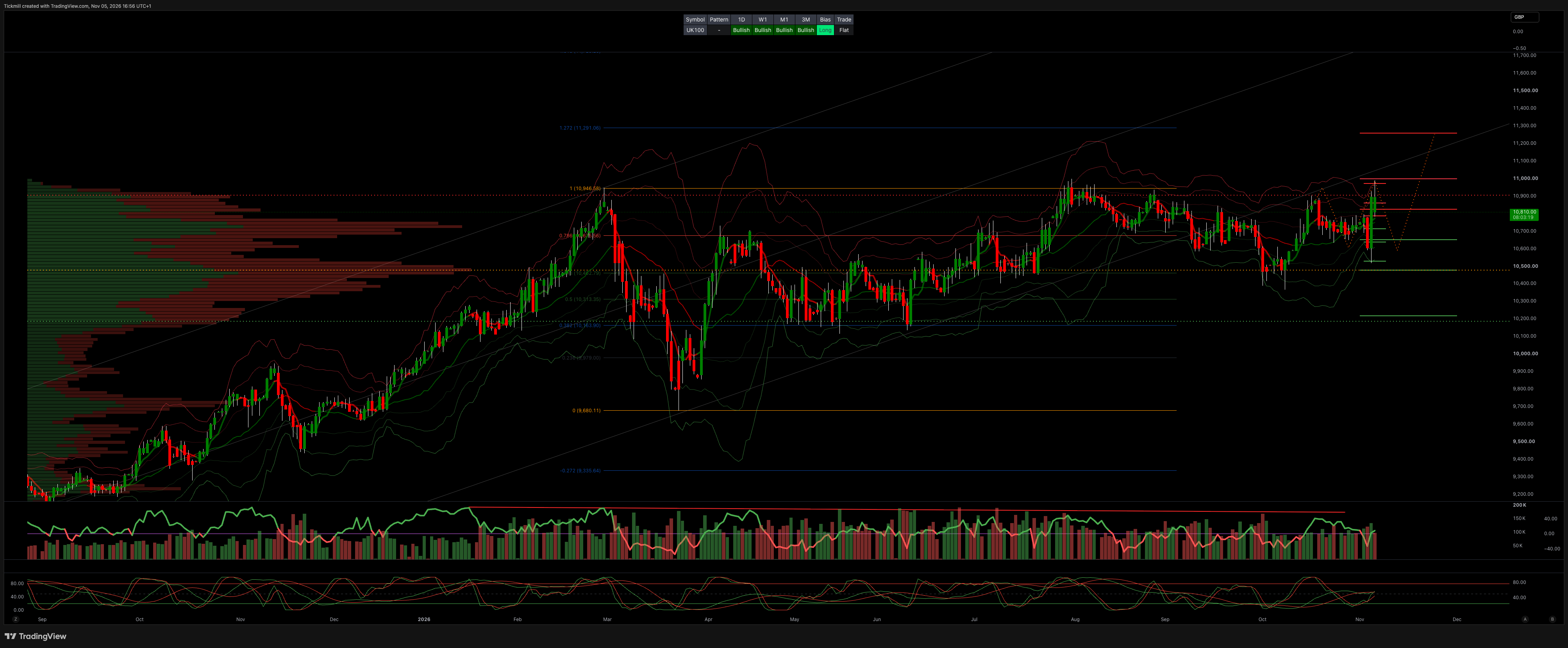
London's benchmark FTSE 100 surrendered an early morning advance to finish in negative territory on Thursday, tracking a sharp afternoon reversal across Wall Street that wiped out yesterday's post-election relief rally. The index initially surged 79.23 points, or 0.73%, to touch an intraday high of 10,908.44 just past noon, but sentiment quickly soured as investors digested a dense corporate earnings docket and a distinctly hawkish 25-basis-point rate hike from the Bank of England.
Mining, telecom, and consumer staples counters provided strong initial upward momentum before afternoon selling pared back gains across the broader market. Natural resource producers rallied early, led by gold miner Endeavour Mining surging nearly 7%, while Fresnillo advanced 3.6%, Rio Tinto climbed 2.5%, Glencore gained 2.3%, and Anglo American Plc added 2.1%. Georgian financial group Lion Finance extended its post-earnings run with a 4.1% rise. Telecommunications major BT Group gained nearly 4% on strong first-half 2027 earnings, while drinks giant Diageo rallied 3.5% after posting an unexpected improvement in quarterly organic sales. Retail bellwether Next climbed over 1% after maintaining its full-year profit guidance, following an 8.1% rise in full-price sales over the 13 weeks to October 31. Broader buying between 2% and 3% was logged across National Grid, InterContinental Hotels Group, Standard Chartered, Croda International, Investec, Kingfisher, WPP, Spirax Group, Airtel Africa, Rolls-Royce Holdings, and Lloyds Banking Group. Conversely, steep declines in defense contractors and tech-adjacent platforms dragged on top-flight performance. BAE Systems tumbled 5.2% to anchor the bottom of the index, while AutoTrader Group slid 3.7%. Moderate losses were also recorded across Babcock International, Associated British Foods, Polar Capital Technology Trust, IG Group Holdings, and ConvaTec Group.
On the monetary policy front, the Bank of England raised the Bank Rate by 25 basis points to 4.00%, ending an eleven-month pause at 3.75% and marking its first rate increase in three years. The Monetary Policy Committee delivered an overwhelmingly hawkish decision: eight members voted for a 25-basis-point increase, while Catherine Mann voted for a larger 50-basis-point hike, with traditional dovish dissenters Swati Dhingra and Alan Taylor voting to tighten policy for the first time since joining the committee. The BoE raised its 2026 U.K. growth projection to 2.0% (up from 1.1%), but warned that CPI inflation will accelerate to 4.5% in Q1 2027 and reach 5.0% in Q2 2027 as corporate absorption of higher energy costs proves temporary. Governor Andrew Bailey stated that while today’s hike is "not inevitable" as the start of an aggressive series, it "does not seem likely to be the last increase," noting that the risk of stronger inflationary pressures has increased since September. Domestic economic indicators presented a stark divergence between construction activity and consumer demand. The S&P Global UK Construction PMI dropped sharply to 43.6 in October from 46.1 in September, missing forecasts and signaling the steepest contraction in construction output since June. Conversely, data from the Society of Motor Manufacturers and Traders (SMMT) revealed that U.K. new car registrations expanded 5.4% year-on-year to 152,730 units in October, marking an eleventh consecutive monthly increase, although this was a slight easing from September's seasonal peak.
Finish Line: U.K. equities mounted a strong early climb toward the 10,900 threshold, only to succumb to late-session selling as a sudden rollover in U.S. markets coincided with the Bank of England's aggressive 4.00% rate decision. With the MPC signaling that further rate hikes remain on the table to counter inflation projected to hit 5%, resilient corporate updates from BT, Next, and Diageo were ultimately overshadowed by tightening financial conditions.
Disclaimer: The material provided is for information purposes only and should not be considered as investment advice. The views, information, or opinions expressed in the text belong solely to the author, and not to the author’s employer, organization, committee or other group or individual or company.
Past performance is not indicative of future results.
High Risk Warning: CFDs are complex instruments and come with a high risk of losing money rapidly due to leverage. 68% and 74% of retail investor accounts lose money when trading CFDs with Tickmill UK Ltd and Tickmill Europe Ltd respectively. You should consider whether you understand how CFDs work and whether you can afford to take the high risk of losing your money.
Futures and Options: Trading futures and options on margin carries a high degree of risk and may result in losses exceeding your initial investment. These products are not suitable for all investors. Ensure you fully understand the risks and take appropriate care to manage your risk.
Patrick has been involved in the financial markets for well over a decade as a self-educated professional trader and money manager. Flitting between the roles of market commentator, analyst and mentor, Patrick has improved the technical skills and psychological stance of literally hundreds of traders – coaching them to become savvy market operators!